
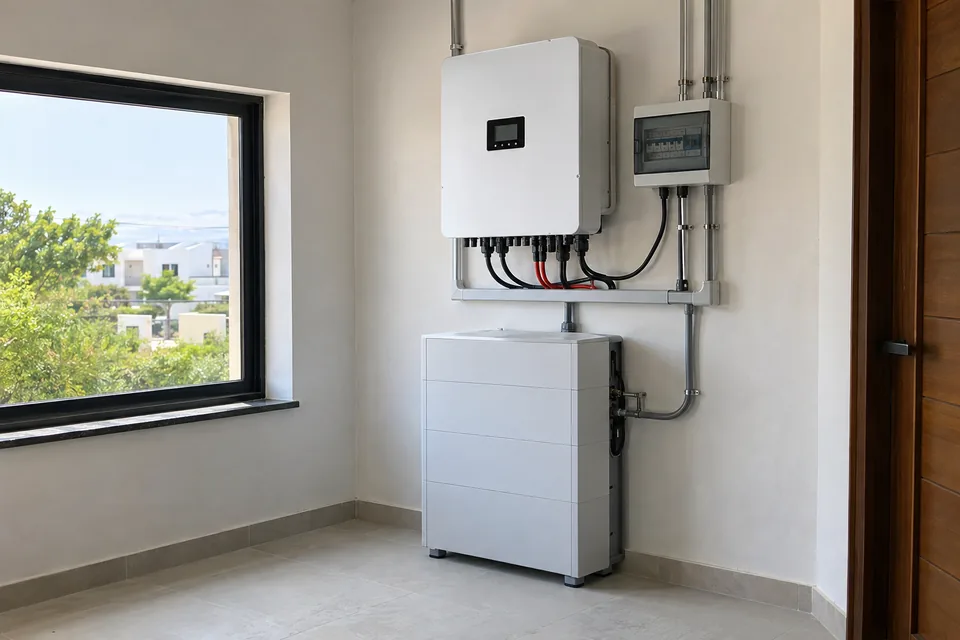
Check the exact battery and inverter models together. Capacity, voltage, communications and supported operation must fit the proposed system. A battery’s energy rating alone does not establish compatibility or backup duration.
Describe the backup task
Begin with the equipment that should continue running and the duration you would like it to run. Separate essential loads from the rest of the property. This turns an open-ended request for a large battery into a discussion with a defined purpose.
Include any load that starts automatically, runs intermittently or needs special attention. If you expect to add equipment later, describe it separately so the current requirement and possible future changes are not confused.
Keep energy and power separate
Energy is commonly expressed in kilowatt-hours; power is expressed in kilowatts. One describes an amount of energy, while the other describes the rate at which energy is used or delivered. Both matter in a storage discussion.
As an arithmetic illustration, a constant 1 kW load uses 4 kWh over four hours before accounting for system losses. This is not a battery recommendation. Real selection needs the available usable energy, equipment limits and the changing load profile to be checked.
Identify the exact equipment
Photograph the label of your existing inverter and battery, if present. Record the model and any available installation documentation. If the equipment is being purchased together, ask the supplier to name both models in the same proposal.
Request confirmation against the manufacturers’ supported combinations and required setup. A family name, a familiar connector or a similar appearance should not be treated as proof that components will work together. The offered configuration should be specific enough to verify.
Ask what happens when the grid is unavailable
Storage can support later use of generated energy, but the complete system determines backup behavior. Ask which circuits are supported, what output limits apply and whether additional switching equipment is required.
If a generator is also part of the plan, include it in the brief rather than assuming an automatic connection. The responsible designer should explain how sources interact. Gateway’s generator, storage and inverter pages provide separate starting points for this joined-up conversation.
Look beyond the purchase price
Ask about operating conditions, installation location, protection and the applicable documentation. Request the manufacturer’s warranty terms and understand which conditions apply to the offered battery and configuration. Avoid comparing systems only by an advertised capacity figure.
For an extension, ask whether the existing installation can support the change. Keep any required additional work visible in the quotation. Record who is responsible for configuration and how the installation will be checked at handover.
Build a clear storage brief
Include your essential loads, desired runtime, existing equipment and available installation space. Add the site location and whether the goal is solar storage, backup support or both. If you have a preferred brand, include it as a preference rather than assuming compatibility.
Use the enquiry planner to save these details. Before agreeing an order, match the final proposal back to the brief and ask for any unresolved assumptions to be written down. A well-defined pair of components is easier to assess than two unrelated product offers.
Explore the next step
Technical reading
The preparation checklists are editorial guidance. These manufacturer and technical references support the underlying equipment concepts.